

Uncategorized
What Does Zero Drop Mean? A Simple Guide to Zero Drop Shoes
Sep
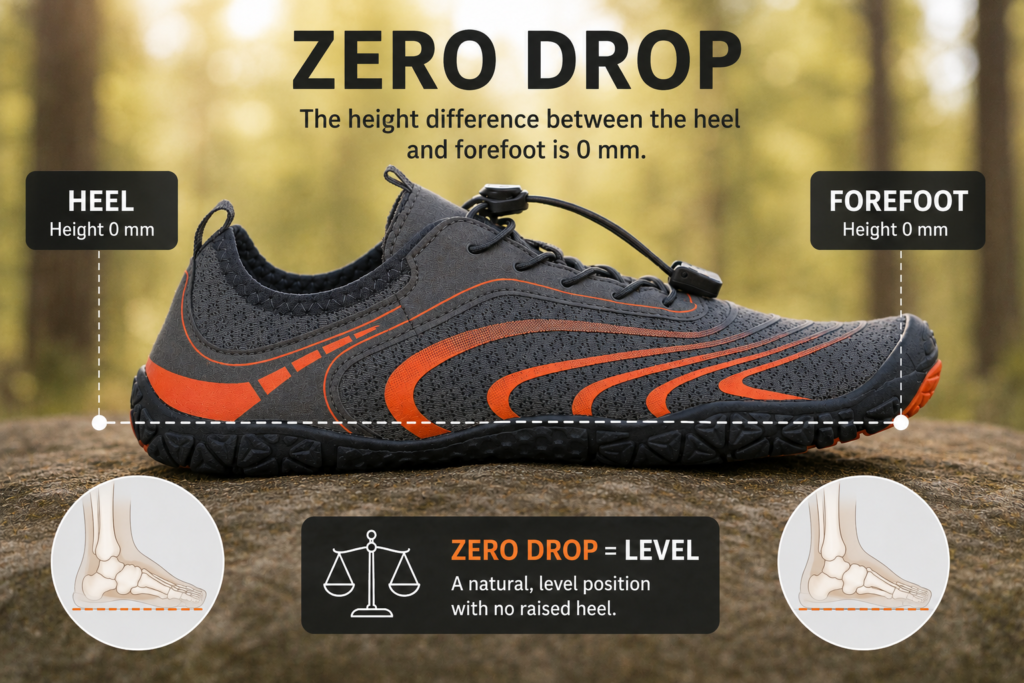
Zero drop means that the heel and forefoot sit at the same height inside the shoe. In other words, there is no intentional height difference between the back and front of the shoe.
The word drop refers to the difference in height between the heel and the forefoot. If that difference is 0 mm, the shoe is considered zero drop.
Zero drop is one of the defining features commonly associated with barefoot shoes. However, a zero drop shoe is not automatically a barefoot shoe. To understand the difference, it helps to look at the whole construction of the shoe.
What does shoe drop mean?
Shoe drop, sometimes called heel-to-toe drop, describes how much higher the heel sits compared with the forefoot.
For example, if a shoe has 12 mm more material under the heel than under the forefoot, its heel-to-toe drop is 12 mm.
If there is no height difference at all, the drop is 0 mm. That is what zero drop means.
This difference is not always obvious from the outside. A shoe can look fairly flat while still having a raised heel built into the midsole or internal structure.
What do zero drop shoes look like?
In a zero drop shoe, the platform under the foot is effectively level from heel to forefoot.
That does not mean the sole has to be thin.
A shoe can have a relatively thick sole and still be zero drop, as long as the stack height under the heel and forefoot is the same or very close to the same.
Likewise, a shoe can look thin and minimal but still have a small heel elevation. In that case, it would not be truly zero drop.
Zero drop vs barefoot shoes: are they the same?
No. Zero drop and barefoot shoes are related concepts, but they are not the same thing.
Zero drop describes only one feature: the relationship between heel height and forefoot height.
Barefoot shoes are usually defined by a combination of features, such as:
- zero drop or a very small heel-to-toe difference,
- a wide, foot-shaped toe box,
- a flexible sole,
- a relatively thin sole, and
- minimal rigid support structures.
A shoe can therefore be zero drop while still being thick, stiff or narrow at the toes. That does not necessarily make it a barefoot shoe.
This is one of the most useful distinctions for beginners to understand: zero drop tells you about heel position, not the entire shoe.
Zero drop vs a raised heel
Many conventional shoes place the heel higher than the forefoot. This height difference may be small or quite noticeable depending on the type of footwear.
| Feature | Zero drop shoe | Shoe with heel-to-toe drop |
|---|---|---|
| Heel height compared with forefoot | Same or nearly the same | Heel is higher |
| Heel-to-toe drop | About 0 mm | More than 0 mm |
| Sole thickness | Can be thin or thick | Can be thin or thick |
| Automatically a barefoot shoe? | No | No |
The important point is that drop does not tell you how thick the whole sole is. It only describes the difference in height between the heel and the forefoot.
Why do barefoot shoes use zero drop?
The basic idea behind barefoot footwear is to reduce unnecessary structures that alter or restrict the natural position and movement of the foot.
Zero drop fits that idea because it does not deliberately raise the heel above the forefoot.
When you stand barefoot on a flat surface, there is no shoe-built heel lift underneath you. A zero drop shoe more closely reflects that basic geometry than footwear with a noticeably raised heel.
This does not mean that zero drop is automatically better for everyone. Footwear preferences and needs vary, and the way a shoe feels can depend on your habits, activities and previous footwear.
Does zero drop mean no cushioning?
No.
Zero drop tells you only about the height difference between the heel and forefoot. It does not tell you how thick, soft or cushioned the sole is.
A zero drop shoe can have a thick, soft sole. Another zero drop shoe can have a very thin, flexible sole.
This is why the terms zero drop, minimalist and barefoot shoe should not be used as if they mean exactly the same thing.
Is zero drop the same as a thin sole?
No. These are two separate characteristics.
Zero drop describes the height difference between heel and forefoot.
Sole thickness describes how much material sits between your foot and the ground.
A shoe can therefore be:
- zero drop with a thin sole,
- zero drop with a thick sole,
- thin-soled with a small heel lift, or
- both thick-soled and noticeably raised at the heel.
Barefoot shoes usually combine zero drop with a relatively thin and flexible sole, but these features are still worth evaluating separately.
Does zero drop mean a flat-looking shoe?
Not necessarily.
The outside shape of a shoe does not always reveal the true heel-to-toe difference. Midsole shaping, removable insoles and internal construction can all affect the height at which the foot actually sits.
If you want to know whether a shoe is genuinely zero drop, the most reliable option is to check the manufacturer’s technical specifications.
Look for terms such as:
- zero drop,
- 0 mm drop,
- heel-to-toe drop: 0 mm, or
- heel-to-toe differential: 0 mm.
If no drop figure is provided, it can be difficult to know the exact difference without measuring the shoe.
What does zero drop feel like?
If you are used to shoes with an elevated heel, zero drop shoes may feel noticeably different at first.
The shoe may feel flatter, and the heel may seem lower than you are used to. This can happen even when the sole itself is not particularly thin.
The difference comes from the geometry of the shoe rather than simply from cushioning or sole thickness.
How noticeable the change feels depends partly on what you normally wear. Moving from a shoe with a larger heel-to-toe drop to zero drop may feel more significant than moving from a shoe with only a small drop.
Do you need to transition gradually to zero drop shoes?
For some people, a gradual transition can be a practical approach, especially after years of wearing shoes with a clearly raised heel.
This is particularly relevant when several characteristics change at the same time. For example, switching from a thick, stiff and raised shoe to one that is zero drop, thin and highly flexible creates a bigger overall change in footwear.
You can start by wearing the new shoes for shorter periods and increase use according to comfort.
There is no need to force the transition. Persistent or increasing pain is a reason to stop and reassess rather than simply trying to push through it.
If you have an existing foot condition, previous injury, reduced sensation or another health issue that may affect footwear choice, consider discussing suitable footwear with a qualified healthcare professional.
Is a small drop basically the same as zero drop?
Technically, zero drop means a heel-to-toe difference of 0 mm.
A shoe with a small positive drop is therefore not exactly zero drop, even if the difference may feel subtle in practice.
The useful principle is simple: the larger the drop number, the higher the heel sits relative to the forefoot.
Zero drop sits at the level end of that scale.
How important is zero drop when choosing barefoot shoes?
Zero drop is important, but it should not be considered in isolation.
If you are looking for a barefoot-style shoe, also pay attention to:
- toe box width and shape,
- sole flexibility,
- overall sole thickness,
- how restrictive the upper feels, and
- whether the shoe contains rigid support elements.
A wide toe box combined with a stiff, thick sole creates a very different shoe from one that is wide, flexible and thin, even if both happen to be zero drop.
The same is true in reverse: a flexible shoe is not automatically a barefoot shoe if the toe box is narrow or the heel is clearly elevated.
The simple zero drop meaning
If you only remember one thing, remember this:
Zero drop means the heel and forefoot sit at the same height inside the shoe.
It does not automatically tell you how wide, flexible, thin or cushioned the shoe is.
That is why zero drop is best understood as one part of the bigger barefoot footwear picture rather than a complete definition on its own.
If you are new to barefoot footwear, learning to recognise features such as zero drop, toe box shape and sole flexibility makes it much easier to compare different shoes and understand what you are actually buying.
Frequently asked questions about zero drop shoes
What does zero drop mean in shoes?
Zero drop means that the heel and forefoot sit at the same or nearly the same height inside the shoe. The heel-to-toe height difference is therefore about 0 mm.
Are all zero drop shoes barefoot shoes?
No. Zero drop is only one feature commonly found in barefoot shoes. A barefoot shoe is also typically wide at the toes, flexible and relatively thin, with minimal rigid support.
Is zero drop the same as a thin sole?
No. Zero drop describes the difference in height between heel and forefoot, while sole thickness describes the amount of material between your foot and the ground.
Does zero drop mean there is no cushioning?
No. Zero drop shoes can still have thick or cushioned soles. The term refers only to heel-to-toe height difference.
Why are barefoot shoes usually zero drop?
Zero drop fits the barefoot footwear principle of avoiding an intentionally raised heel and allowing the foot to sit on a more level platform.
Should beginners transition slowly to zero drop shoes?
A gradual transition can be sensible if your usual shoes have a noticeably raised heel, particularly if you are also switching to a thinner and more flexible shoe at the same time.
